
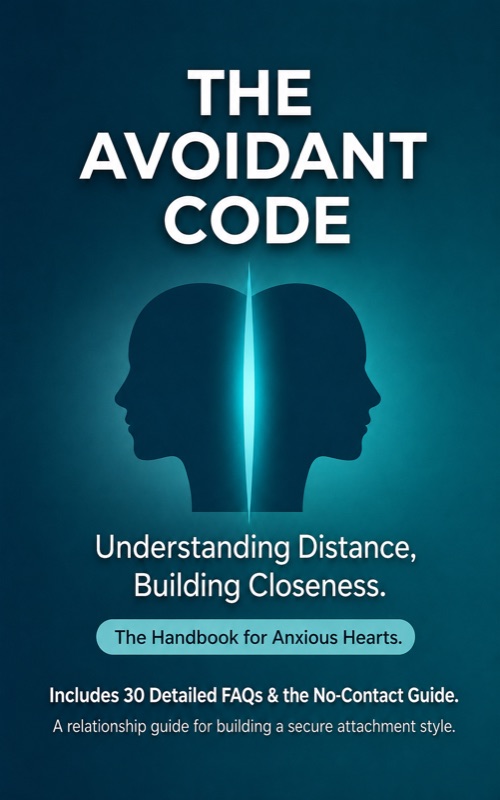
When love feels like a riddle
You had a beautiful weekend. You laughed, you talked about real things, the closeness was intense, and you finally felt safe. Then you wake up the next morning and the air has frozen. Short replies. A distant look. Every emotional question met with irritation.
And then the spiral starts: What did I do wrong? Was I too much? Why do they withdraw love exactly when things were at their best?
Your partner isn't pulling away because you are too much. They're pulling away because closeness reads as danger.
Avoidant behaviour follows an internal script, a code usually written in early childhood. Attachment research calls it the internal working model: a deeply burned-in expectation of what happens when you show another person your heart. For people carrying this code, closeness doesn't mean safety. It means loss of control.
Here's the comforting part: this is one of the best-documented patterns in relationship psychology. It has a name, an origin and an internal logic. And what you understand loses its power to frighten you.
What's inside the book
-
The map of attachment
Bowlby, Ainsworth, the four attachment types, and the distinction missing from almost every popular guide: dismissive-avoidant or fearful-avoidant. It decides what you can realistically expect. Includes two self-tests.
-
The mechanics of avoidance
Why withdrawal follows closeness rather than conflict. The emotional thermostat, hyper-autonomy, and why your rescue attempts never land where you aim them.
-
The deactivating strategies
Fault-finding as defence. The idealised phantom no real person can match. The backlash after every milestone. Once you see the timing, you stop looking for the mistake in yourself.
-
The rewrite
The language that actually lands: expressing needs without creating pressure, with word-for-word phrasing for the conversations that used to go wrong every time.
-
Your red lines
Where patience ends and self-abandonment begins. How to tell real change from empty words, and how to recognise when the code won't be cracked.
-
The No-Contact Guide
A full chapter on going no contact: the three phases, the four rules, the relapse plan, and what to do when the submarine surfaces again. Plus 15 extra FAQs on this topic alone.
- 30 detailed FAQs
- The first-aid kit for hard moments: from “Why was everything perfect at the start?” through “What do I say when they call me clingy?” to “When does fighting for this become self-destruction?”
- The Golden Manifesto
- Ten sentences that define your new standard, your compass, whether you stay with this partner or walk a new road.
Who it's for
Right for you if
you love someone who backs away when things get close. If you swing between hope and exhaustion. If you want explanations that go beyond “that's just how they are”, and tools that hold up in everyday life.
Not for you if
you're looking for a manual to change them. It doesn't exist, and this book doesn't promise it. It also doesn't replace therapy, if this relationship is pulling you into depression or anxiety, get professional support.
The research behind it
This book combines two things that rarely meet: the warmth of a conversation between good friends and the substance of attachment research. The core concepts, the safe haven, internal working models, hyperactivating and deactivating strategies, earned secure attachment, come from decades of research: John Bowlby and Mary Ainsworth, Cindy Hazan and Phillip Shaver, Kim Bartholomew, Mario Mikulincer and Sue Johnson. A full bibliography is included.
What it deliberately isn't: an academic textbook. It speaks to you directly, because the subject is too intimate for anything else.
Please note: This book is not a substitute for psychotherapy. It helps you understand, stabilise and decide more clearly. If you notice this relationship pulling you into depression, anxiety or real despair, get professional support. In a crisis in the US: call or text 988 (Suicide & Crisis Lifeline). In the UK: Samaritans on 116 123. Emergency services: 911 / 999.
Common questions about the book
Does the book help if the relationship is already over?
Yes, a dedicated part covers exactly that situation: the breakup, the delayed grief on the other side, the no-contact phase, and what to take from the pattern into your next relationship. Understanding works backwards too, it ends the loop of asking what you did wrong.
Can this book change my partner?
No, and it does not promise to. No book changes a person who does not want to change. What it does: you understand what is behind the withdrawal, you respond in ways that do not make it worse, and you recognise whether movement is possible or not. The third is the most valuable in the end.
Is it a substitute for therapy?
No. It is education grounded in attachment research, written for everyday life, with its limits stated plainly: with lasting distress, anxiety or depression, professional support belongs in the picture, and the book tells you how to recognise that point.
Keep reading, free
The core themes of the book are available here as in-depth guides. Best place to start:
Foundations
Avoidant attachment style: signs, causes and how to respond
The full overview, the two avoidant types, the deactivating strategies and six principles for everyday life.
Self-assessment
Attachment style test in 8 questions
Secure, anxious, avoidant or fearful-avoidant? Instant result, no sign-up, no email required.
Overview
All guides
The full knowledge base, sorted by perspective.